
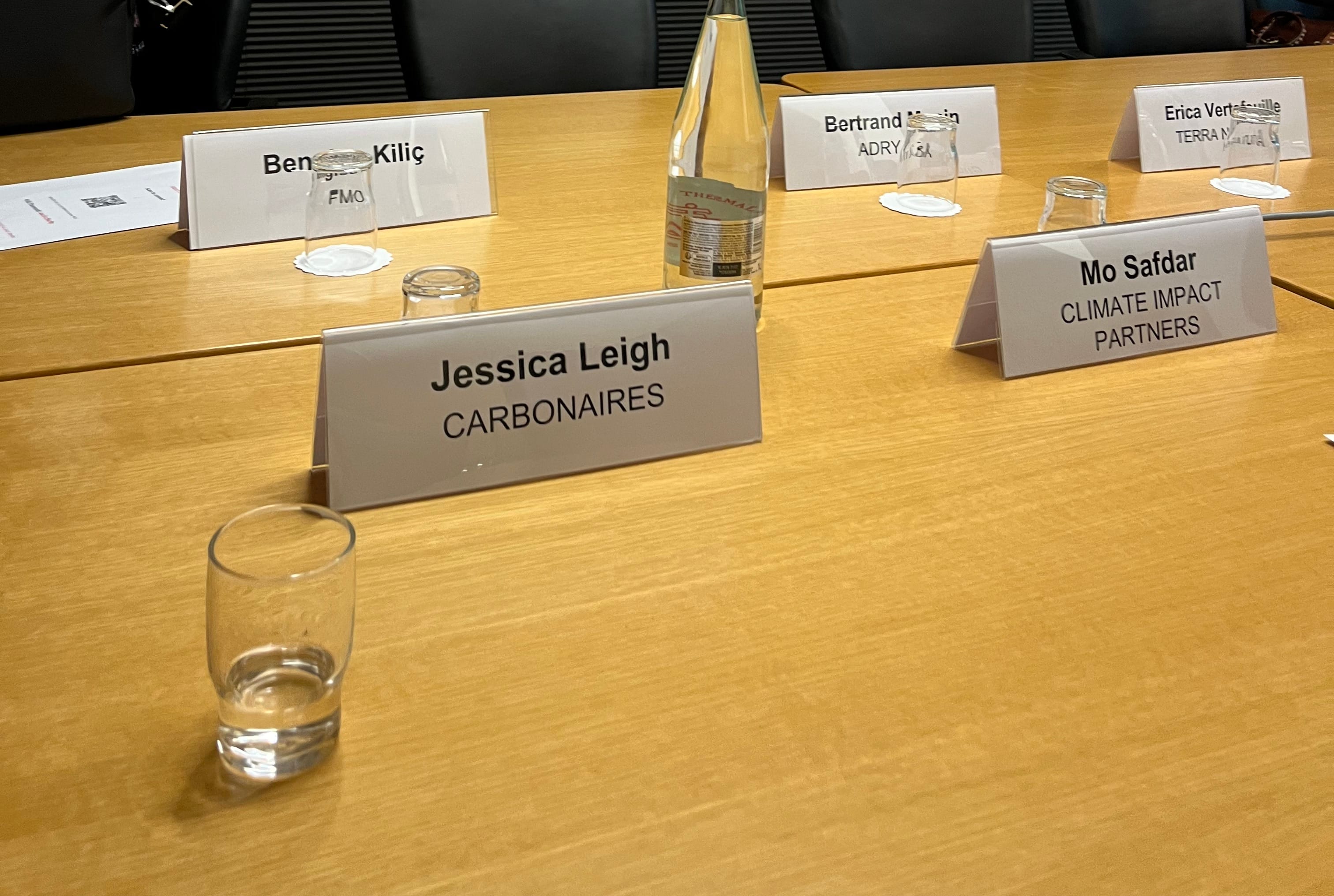
The World Bank Group’s Nature-Smart Business Solutions Workshop brought together senior investors, development finance institutions, project developers and carbon market specialists in Paris on 31 March 2026. With over 35 participants from organisations spanning BNP Paribas, FMO, AXA, Mirova, Imperative, Ponterra and the IFC itself, the agenda was deliberately cross-sectoral: how do private companies and financial institutions build commercially viable business models that halt and reverse nature loss? The day combined short presentations and market case studies with two rounds of sector roundtables (Agri, Infra and NBS for Carbon and Forestry) and a closing cross-sector roundtable focused on collaboration between companies with complementary business needs. Jessica Leigh, Carbonaires’ Nature-based Solutions Lead attended, and this is our read of the day.
1. Nature Finance Is Now an Official Asset Class, and Carbon Is Just the Entry Point
Nature finance has been formally recognised as the newest sub-label under green finance, sitting alongside climate mitigation, climate adaptation and blue finance. This is not a semantic shift. It changes how financial institutions classify, report and deploy capital.
The IFC framed nature finance as a whole-of-economy transformation, not conservation dressed up in commercial language. The vast majority of human pressure on nature comes from four economic systems: food, energy, infrastructure and fashion. The projects that qualify reflect this breadth, spanning reforestation, regenerative agriculture, waste management, sustainable aviation fuel and beyond. Carbon is one tool in that toolkit, not the destination. Carbon removal and broader climate finance are increasingly seen by institutions like the IFC as stepping stones into nature finance at scale. The carbon credit is the mechanism that makes early-stage projects bankable; nature restoration is the outcome that makes them credible.
Carbonaires’ view: We have observed this shift in our own work. Conversations that began purely around carbon credits are increasingly expanding into questions about biodiversity co-benefits, ecosystem services and long-term land use. For corporate buyers building a carbon removal portfolio, this matters: projects designed with that breadth from the outset are more likely to age better than those built narrowly around a single credit type.
2. Cross-Sector Partnerships Are the Unlock, But the Matchmaking Gap Remains Large
The IFC presented three cross-sector partnership models: Ecosystem Services Partnerships, Landscape Protection Partnerships and Product-Based Partnerships. The logic is straightforward. Companies in different industries have complementary dependencies on nature. A data centre needs water security. A regenerative agriculture business improves watersheds. A mining operation produces mineral by-products that can be applied to farmland as part of enhanced rock weathering, improving soil health while sequestering carbon. These interdependencies are material business cases that are not yet being systematically identified or structured.
The IFC made clear they need intermediaries to identify these opportunities and bring parties to the table. The Google-Indigo Ag partnership in Oklahoma, where a technology company funded regenerative agriculture to protect the watershed supplying its data centre, was cited as a live example. These models work. They are simply not being replicated at the pace the opportunity warrants.
Carbonaires’ view: The three partnership models outlined by the IFC closely reflect the transaction types we see as most underserved in today’s market. The constraint is rarely a lack of willing counterparties; it is the absence of an intermediary capable of systematically identifying and structuring these matches in a way that works commercially for all participants.
This is core to how Carbonaires operates. We work across both supply and demand, meeting clients where they are, whether a project developer seeking the right capital partner or an institutional buyer looking for credible, investment-grade supply. This positioning enables us to identify and structure the cross-sector transactions the IFC is calling for.
3. The Revenue Stream Debate Is Exposing a Fault Line Between Investor Types
Should nature-based carbon projects rely on a single revenue stream or multiple? The divide is becoming increasingly clear. Carbon-focused investors favour simplicity: additional revenue streams, whether biodiversity credits, timber or agricultural output, often introduce pricing complexity without materially improving bankability. In some cases, they can also blur the project’s additionality case, making it harder to demonstrate that carbon revenues are truly driving the outcome.
Development finance institutions have historically taken the opposite view, preferring diversified revenue models. But this position is shifting. At least one DFI in the room signalled a willingness to back pure carbon plays, reflecting growing confidence in carbon credits as a standalone asset class, and in their ability to support credible additionality claims.
Carbonaires’ view: There is no universal model, but indecision is a problem. Too many projects enter financing discussions without a defined revenue strategy or a clearly articulated additionality case, creating avoidable friction. At Carbonaires, we place significant emphasis on rigorous additionality due diligence to ensure that both the revenue structure and the underlying additionality logic are robust, defensible and aligned with investor expectations. These questions should be resolved early, not debated when capital is already on the table.
4. Pricing Opacity Remains the Market’s Most Persistent Structural Problem
The voluntary carbon market is increasingly being treated like a commodities market, but it still lacks the market infrastructure that makes commodities markets function. There are no reliable price benchmarks, no transparent forward curves and no shared methodology for quantifying risk reduction in dollar terms. The result is inefficient capital allocation. Several investors in the room only back offtake-backed projects because the spot market offers no reliable hedge. Large buyers purchase at prices that signal quality at the top of the market, but credits below that threshold struggle to find buyers at consistent prices. The broader buyer base remains under-engaged, and without it the market cannot scale beyond its current concentration.
Carbonaires’ view: Pricing transparency is one of the areas we are most focused on. The absence of reliable benchmarks affects every stage of a carbon credit transaction, from initial project valuation through to carbon offtake agreement negotiation and financing terms. We are developing pricing models to support both spot and forward carbon credit transactions. Our aim is to give all parties involved in a deal a more consistent and defensible basis for their numbers, independent of which side of the table they are sitting on.
5. Project Developer Quality Is the Variable Institutional Capital Cares About Most
Across the sector and cross-sector roundtables, one point was made consistently: the quality of the on-the-ground project developer team is one of the most important variables in determining whether institutional capital will commit. The developers who commanded the most credibility had established local entities, built genuine relationships with community stakeholders and embedded themselves in the landscapes they were working in before seeking financing. This determines whether FPIC processes hold under scrutiny, whether permanence risks are genuinely managed and whether a project survives the transition from development to verification intact.
One framing from the floor was particularly useful: these projects need to be treated as infrastructure investments. The timelines, the stakeholder complexity, the capital requirements and the long-dated return profiles are all closer to infrastructure than to a conventional private equity transaction.
Carbonaires’ view: Developer team quality is something we assess carefully in our carbon removal due diligence. Financial modelling and methodology compliance matter, but they are not sufficient on their own. A project with strong numbers and a weak team on the ground carries more risk than a project with conservative projections and a developer who has earned the trust of the communities they are working with. We think the market is beginning to price this more accurately, and that is a positive development.
What This Means for Carbon Markets
Demand for high-quality carbon credits is consolidating around projects with credible methodology, strong on-the-ground execution and verifiable co-benefits. That consolidation is a sign of growing market discipline, not contraction. As investor frameworks sharpen, the projects that meet the bar are attracting deeper and more diverse capital than before.
The convergence of carbon-specialist investors and traditional institutional capital on the same opportunities is creating new space for intermediaries who can bridge both worlds. The structural challenges that remain, pricing opacity, developer quality variance and the absence of cross-sector partnership infrastructure, are well understood and increasingly attracting the institutional attention needed to address them. The presence of organisations like the IFC, AFD, FMO and AXA in the same room, working through these constraints together, is itself a signal that the market is entering a more mature and investable phase.
Carbonaires’ Perspective
The carbon market is at an inflection point. The institutional debate has moved on from whether carbon credits have value to how that value should be structured, priced and risk-managed. That is a meaningful shift — and it changes what it takes to participate.
Three things became clearer in Paris. First, cross-sector partnership models represent the next significant opportunity in nature finance, and they remain largely unaddressed at scale. Second, pricing transparency is a prerequisite for market maturity, not a consequence of it. Third, the quality of execution on the ground — not the quality of the pitch deck — is what separates projects that attract institutional capital from those that stall.
At Carbonaires, we sit at the intersection of carbon credit supply and demand: connecting project developers with aligned capital partners, structuring carbon offtake agreements and building the intermediary infrastructure this market needs to scale. If you are navigating carbon credit procurement, building a carbon removal portfolio or exploring climate investment opportunities, we would welcome the conversation.