
Superpollutants are non-CO2 climate pollutants with high warming potency and, mostly, short atmospheric lifetimes. The term covers methane (CH4), black carbon soot, tropospheric ozone and hydrofluorocarbons (HFCs), plus the longer-lived nitrous oxide (N2O). Market practice also folds in ozone-depleting substances (CFCs and HCFCs) and other F-gases such as SF6.
Superpollutants are responsible for roughly half of the warming experienced today and account for over a quarter of annual anthropogenic GHG emissions, around 15 GtCO2e per year, although this may be an underestimate given newer satellite data suggesting methane emissions are larger than reported.
What happened
Superpollutants have increasingly moved to the centre of the carbon conversation over the past year. They dominated discussion at New York Climate Week in 2025 and again at COP30 in Belém last November, where $278 million in new funding for methane and superpollutant abatement was announced. Alongside this, the Carbon Containment Lab and Calyx Global published the field’s most substantial market study to date, drawing on more than 1,000 integrity ratings. All of this sits against a backdrop of policies around the world for the phasedown and phase-out of these gases.
Within the market, the biggest signal has come from Google. Google contracted credits equivalent to eliminating one million tonnes of CO2 through partnerships with Recoolit, destroying HFCs from cooling systems in Indonesia, and Cool Effect, funding methane destruction at a landfill in Brazil. This was Google’s first move into superpollutants alongside an existing removals portfolio. On the integrity side, superpollutants were the very first categories through the ICVCM gate: landfill methane and ozone-depleting substance destruction earned CCP labels in 2024, and coal mine methane followed under conditions in May this year.
However, as with much of the carbon markets in the early 2000s under the Kyoto Protocol’s Clean Development Mechanism (CDM), superpollutants have had integrity issues. The CDM’s HFC-23 destruction projects generated enormous Certified Emission Reduction (CER) volumes, at one point nearly half of all CERs, and credit revenues exceeded production costs by so much that plants were suspected of manufacturing HCFC-22 partly to destroy the by-product. The EU banned HFC-23 and adipic-acid N2O CERs from the ETS in 2013 and the CDM tightened crediting. This single episode is why ‘industrial gas credits’ carried a stigma for a decade, and why modern methodologies include additionality safeguards such as capped crediting rates, the exclusion of new production lines and requirements to demonstrate that revenues don’t incentivise increased production.
Why it matters
Superpollutants drive the rate of near-term warming rather than the long-term ceiling, and they are responsible for roughly half of the warming observed today. Because they are potent and short-lived, abating them is now seen as the fastest available lever on temperature this decade. This potency matters enormously in accounting: methane has a Global Warming Potential (GWP) of 81.2 over 20 years versus 27.9 over 100 years. Methodologies conventionally credit at GWP100, but some practitioners argue GWP20 would better represent the near-term impact, and the choice directly affects credit volumes.
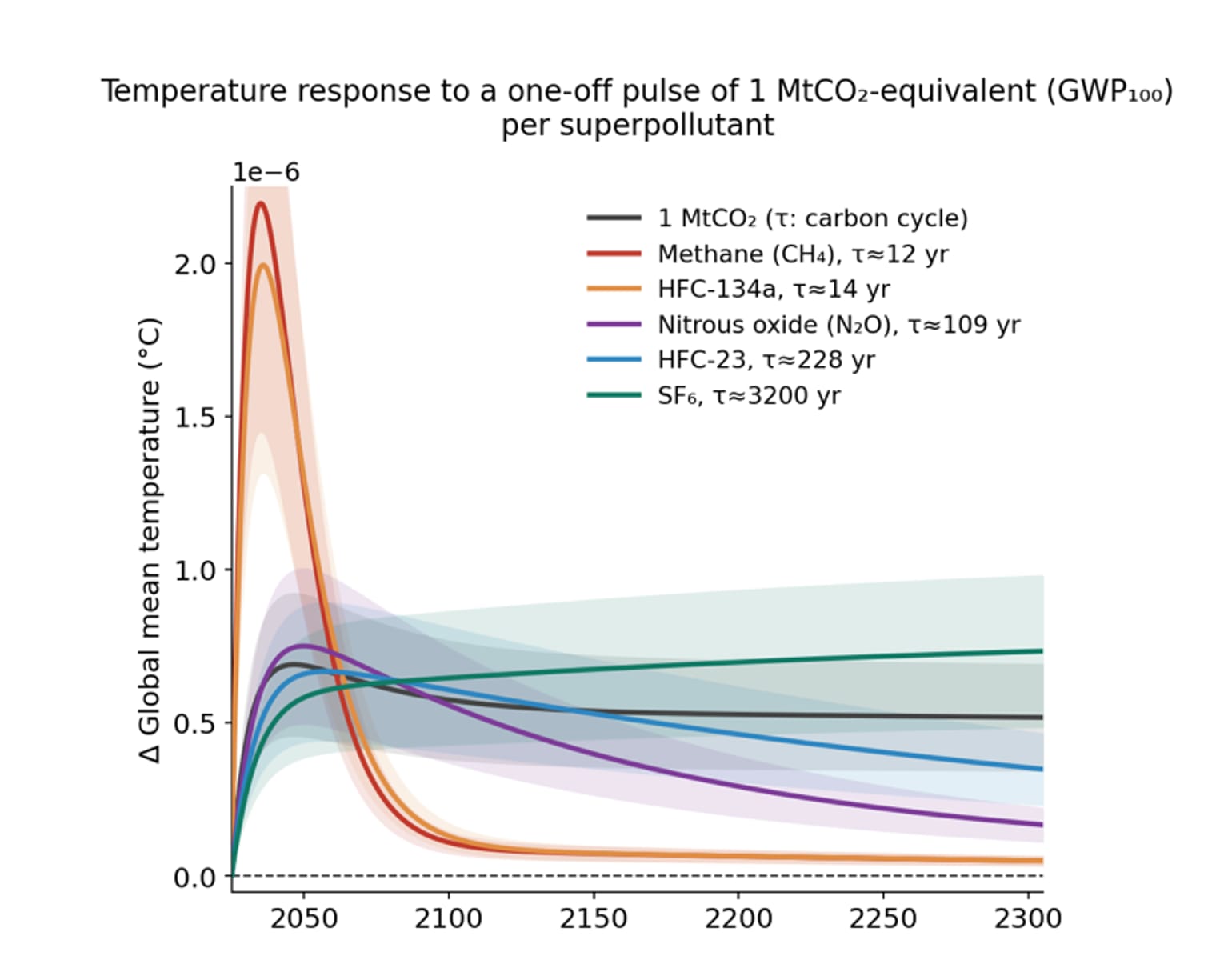
In the context of building a credit portfolio, these credits compete with removal credits without the higher prices. Since these reductions cannot be reversed the way carbon removal can, durability risk is effectively zero. Independent raters are now placing the best superpollutant credits among the highest quality in the market, typically at lower price points than nature-based or engineered alternatives. The CCP label has already moved the market, with approved landfill gas prices rising sharply and volumes more than doubling after approval. It is worth noting, though, that these are avoidance credits, not removals.
What’s next
There are three areas Carbonaires is monitoring. First, demand: there is still no Frontier-style advance market commitment for superpollutants. Second, the metric debate: there is growing pressure to credit on a 20-year basis and to separate near-term warming claims from CO2 offsetting, which would create a distinct product class. Third, HFC destruction methodologies are migrating from boutique registries toward the major standards, and the regulatory tailwinds continue to tighten.
For Carbonaires, superpollutants offer CCP-labelled credits rated among the market’s highest quality at a fraction of removal prices, supported by policy momentum and a small but blue-chip buyer base led by Google. The risks are concentrated and identifiable: additionality at the project level, where energy-revenue or regulatory baselines can undercut the case; the avoidance-versus-removal implications for corporate claims; and policy displacement, as voluntary credits move toward compliance obligations.